This is the one that tastes most strongly of the pindo palm fruit
2 cups cooked and strained Pindo palm puree/juice
1/2 cup sour orange or lemon juice
2 cups simple syrup (or more to taste)
What's the difference between wild fruit and domestic fruit? Wild fruit has a stronger, fruitier taste, is usually more nutritious, and smaller. Domestic fruit is usually larger, but the flavor is sacrificed for size. Also, wild fruit isn't genetically modified, nor irradiated or treated with harsh herbicides and insecticides.
Most of our fruits are wild fruits, not domestic fruit and are seasonal fresh. Some like the Palm are domestic but also very good fresh.

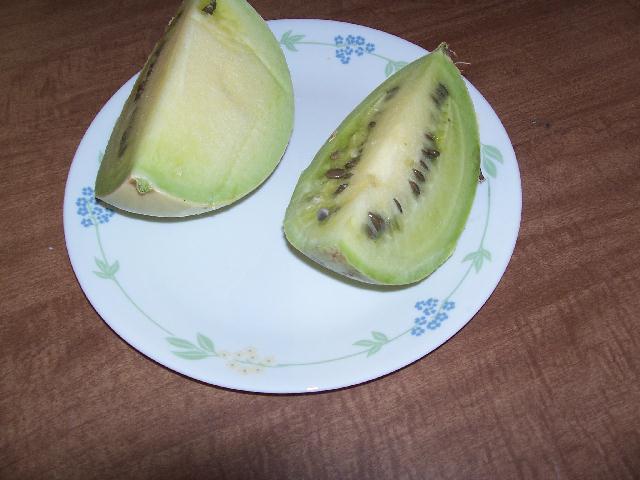
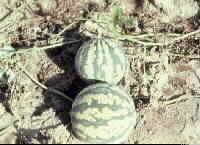
Citron melon / wild watermelon / preserving melon - $2.00/lb plus shipping
You have to buy a whole melon as we do not sell slices. Various sizes, various weights. Anywhere from 2 lbs. to 5 lbs.
Prickly Pear Fruit (tunas) - $5.00/lb, plus shipping (minimum order 1 lb.)
Hawthorns from Georgia

Yellow Hog Haw
(Crataegus flava Aiton
yellowleaf hawthorn) -
fresh fruit -
1 quart $15.00, plus shipping
(late summer, early fall)
Grapes, wild muscadine, fox or fall grapes - Middle - late summer - $20/gallon, plus shipping
Elderberry - 1 quart $20, plus shipping (summer only)
Wild Plums (summer)

Wild Plums - Late May - early June - $10.00/lb, plus shipping (minimum 1 lb.)
Black Berries - Mid-June through July 15 - $12.00/lb, plus shipping (minimum 1 lb.)
Wild Persimmons - Fall - $10.00/lb, plus shipping (minimum 1 lb.)
Wild Cherries - Early June - July - $10.00/lb, plus shipping (minimum 1 lb.)
Wild Crab Apples - $8.00/lb, plus shipping (fall) (minimum 1 lb.)
Staghorn Sumac berries - $8.00/lb, plus shipping (minimum 1 lb.)
Autumn Olive Fruit
- available late summer - early fall - $25.00/lb, plus
shipping (fresh), minimum order 1 lb.
Autumn Olive Fruit (dried):
$3.00/1 oz.
$11.00/4
oz.
$20.00/8 oz.
$35.00/16 oz.
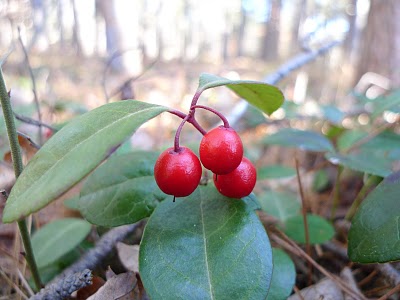
Teaberries
- late fall/winter - $25.00/lb, plus shipping (minimum order 1 lb.)
Photo by Katie - click photo to go to her Blogspot site.

Fresh pindo palm dates
$3.00/lb, plus shipping, minimum order 1 lb.
(seasonal - available early September, 2008)
Butia capitata
Common Names: jelly palm, pindo palm, wine palm
Family: Arecacea/Palmae (palm Family)
Eat fresh or put into jams, jellies, cakes. Tart/sweet flavor, a tropical
surprise. The sweet-tart flavor is reminiscent
of both apricots and a pineapple-banana mixture.
http://davesgarden.com/community/forums/t/466731/
Butia Palm Fruit Jelly
Preparation of Juice:
3 quarts fully ripe fruit
6 cups water
Sort fruit, wash and remove sepals if still attached. Barely cover with water
(about 6 cups), bring to a boil, cover and simmer for about 30 minutes. You can
try to crush the fruit with a potato masher after it starts to cook; however,
the seeds are so large that the masher only partially crushes.
Drain juice through colander, then strain two or three times through several
thicknesses of damp cheesecloth or some other thin clean cloth. Let set in
refrigerator overnight because it will still contain lots of solids. Pour off
juice leaving residue in bottom of container, and strain again. The juice may
never be perfectly clear. The natural color is a yellowish amber. The jelly is
much prettier if tinted with red food coloring.
Making the Jelly:
5½ cups strained juice
1 box powdered pectin
Few drops red food color
7½ cups sugar
Measure juice into a 6- or 8-quart saucepan. Mix pectin with juice until
dissolved, add food coloring, and bring quickly to a hard boil, stirring
occasionally. Add sugar all at once. Stir until sugar dissolves. Bring to full
rolling boil (a boil that cannot be stirred down); boil hard for 1 minute and 15
seconds, stirring constantly. Remove from heat; skim off foam with metal spoon.
Pour into sterilized jelly jars, leaving 1/8-inch headspace. Wipe sealing edge
clean and seal with new lids. Invert jars until all are sealed; stand upright to
cool. Yield: about 8 half-pints.
How another lady made the jelly:
http://www.cloudforest.com/cafe/forum/57049.html
I just made a batch of jelly from the pindo palm in in my yard. I got about a gallon of fruit, and cooked it with a cup of water in a large pot for a couple of hours (simmer). I then left the pot on the stove overnight, and drained the fruit first thing in the morning through four layers of cheesecloth tied up above a bowl. This took about 4 hours. I got 2 cups of juice, to which I added 3 and 3/4 cup sugar. Bring to rolling boil and add 1/2 pouch of liquid pectin (about 1/4 cup). Seal and process 10 minutes. It's LUSCIOUS.
The above followup was added by Carol on August 02, 2008 at 9:23 am PST.
http://www.meaningfulpursuit.com/
edibleplantproject/2008/07/pindo-palm-sorbets/
2 cups cooked and strained Pindo palm puree/juice
1/2 cup sour orange or lemon juice
2 cups simple syrup (or more to taste)
We're looking for a supplier for the following fruits:
Huckleberries - Early May - June - looking for a supplier
Choke Cherries - looking for a supplier
Ground Cherries - looking for a supplier
Pin Cherries - looking for a supplier
Paw Paw - looking for a supplier
Strawberry, Wild - looking for a supplier
Deer berry/bear berry - looking for a supplier
Passion fruit (aka vine apricot) - looking for a supplier
Wild Raspberries - looking for a supplier
Gooseberries - looking for a supplier