
Wild Greens
All fresh greens are seasonal, wild harvested and not commercially grown.
Cochan, Sochan (Sochani) Greens - (Rudbeckia laciniatum)are available in the spring
We can offer fresh leaves this spring and summer.
$3.00/lb. , plus shipping (overnight).
1 lb. is a gallon bag size full, but we ship in paper as plastic makes the leaves deteriorate faster.
"Sochan, called green-headed coneflower by non-Indians, is one of the most prized spring greens the Cherokees gather.
They sometimes call it “sochani.” Many of their gardens have semi-cultivated patches of the plant in protected areas. Closely related to black-eyed Susan (“Rudbeckia hirta”), it grows to 10 feet tall in wet areas and along damp woodland borders. The flower heads that appear in mid-summer are about three inches wide with drooping yellow rays and a center disk (unlike the purple disk of black-eyed Susan) that’s greenish-yellow.
The Cherokees recognize sochan as soon as it comes out of the ground in mid-spring by its distinctive irregularly divided leaves and smell. Consult your wildflower field guides for flower and leaf-shape diagrams of green-headed coneflower.
Then you will be able to locate the plant this summer along backcountry roadways when it’s in full bloom. Mark the spot and return next spring for greens.
Prepare the young shoots and leaves (boiled with several changes of water) have a rich texture and zesty flavor. It’s even good cold as a snack with a little vinegar added. In the opinion of many - this writer included - sochan is the very finest of the traditional potherbs gathered in the Blue Ridge region."
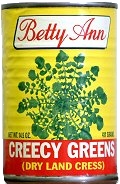 Creecy Greens
-
Barbarea verna
-
Creecy Greens
-
Barbarea verna
-
Betty Ann Creecy Greens are no longer available in any grocery stores. McCall Farms has taken them off their products list. This ethnic Southern dish will be missed.
We still have six cans left and they are probably the last you will see that haven't been opened. This would be for a memorabilia item and probably you would not want to eat them. The code on the top of the can says Best By Mar 2009. They would be a very novel addition to your kitchen decor.
Each can is $20.00, plus shipping. Yes they are expensive and that's because they can never be replaced.
Fresh greens available in early spring.
$3.00/lb. plus shipping
|
Gone but not forgotten..... |
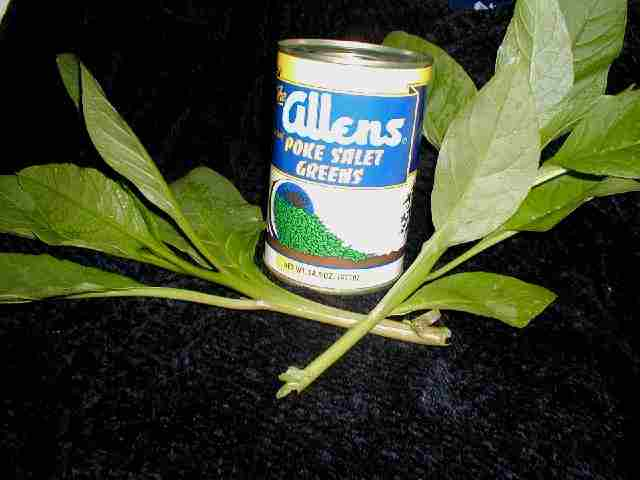
Photo by M. Morris - Copyright 2011 - Use by permission only.
If any of our photos are plagiarized by you or your company, we will send you a bill for $50.
Young shoots/sprouts that are no more than eight inches long can be prepared in a number of ways: like asparagus; cut and fried golden brown in a cornmeal batter like okra; and fried whole or cut up with scrambled eggs. Young leaves are prepared as a potherb green in two changes of boiling water, then fried.
Allen's has stopped canning poke. Please email them with a request to continue the delicious product!
Pokeweed Plant (Phytolacca americana)
Poke Salad Greens (also called in the South as "salat, sallet, salet, sallit, or sallat") cannot be eaten raw in a "salad", poke weed, poke greens).
Fresh poke greens are seasonal and available as Mother Nature dictates, usually early spring to just before summer.
1 lb. fresh greens is $2.00, plus USPS Priority shipping. If you live in the mid-west or on the west coast, we have to ship UPS because the USPS office takes 5 days to delivery even if sent Priority. Greens hold up well for no more than 3 days shipping. We can ship via UPS second day ground.
Overnight Express is available and recommended.
If you want just the stems or stalks for pickling for frying like okra, please advise amount and we can quote a price per pound on just the stems.
Just about everyone who was born and raised in the South has heard about poke 'salat' greens. Among the Appalachian mountain people here in Tennessee, it is and was known as a nutritious, tasty spring green. Native Americans introduced this plant to European settlers and fast became such a popular potherb that seeds soon were being cultivated back in Europe.
In the spring, the tender young shoots are picked and boiled in two changes of water to help remove any toxic properties. Traditionally the drained leaves are then seasoned with salt, pepper and bacon drippings and then fried in an iron skillet. Some people add eggs and/or corn meal. Personally, any way you fix spinach or other greens will work with poke greens. They have a bland taste but can be combined with other green for an interesting mixed green dish.
The nutritional value is outstanding. One half cup of the greens will provide 35 calories (calories from fat 10), no cholesterol, dietary fiber 3g, and 90% of Vitamin A, 60% of Vitamin C, 8% calcium, and 6% of iron. (Percent Daily Values based on a 2,000 calorie diet.)
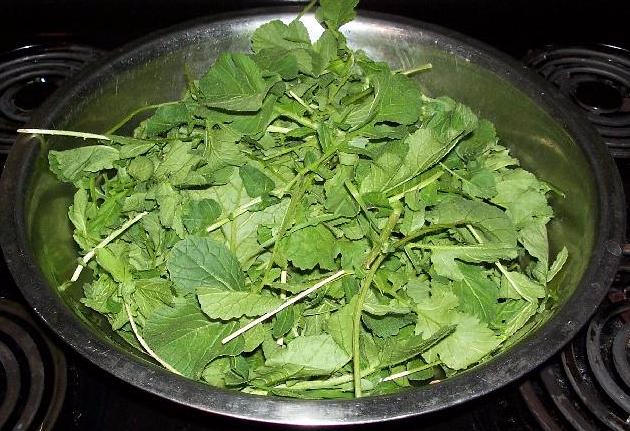
Photo by M. Morris - Wild Pantry © 2007
Wild Mustard Greens (December - January - February)
Wild Mustard (Brassica
rapa L.), also known as
Field Mustard, bird's rape, birdsrape mustard, wild
mustard,
wild rutabaga, and wild turnip can be found
throughout the United States. It is delicious fixed with any recipe calling for
mustard greens.
1 lb. of fresh greens is $3.00, plus over night shipping
Email to order______________________
Bastard cabbage (Rapistrum rugosum)
Synonym(s):
Family: Brassicaceae (Mustard Family)

Two subspecies of this plant are recognized: R. rugosum ssp. rugosum and R. rugosum ssp. orientale.
Bastard cabbage is also known as turnip-weed, common giant mustard, ball mustard, wild turnip, wild rape and tall mustard-weed.
Distribution
U.S. Nativity: Introduced to U.S.
Native Origin: Native to southern European (i.e. France, Portugal, Spain, Albania, Bulgaria, Greece, Italy, Yugoslavia, Ukraine and southern Russia), the Azores, the Madeira Islands, the Canary Islands, northern Africa (i.e. northern Algeria, Egypt, northern Libya, Morocco and Tunisia) and western Asia (i.e. Cyprus, Iran, Iraq, Israel, Lebanon, Syria, Turkey, Armenia, Azerbaijan, Georgia, Kazakhstan and Turkmenistan).
U.S. Present: CA, HI, IL, IN, LA, MA, MO, NJ, NM, NV, NY, PA, SC, TN, TX, WI
(source: http://texasinvasives.org/plant_database/detail.php?symbol=RARU)
The leaves are somewhat like the common mustard plant, but they are smooth and not coarse. The taste is much milder and similar to collard greens.
1 lb. of fresh greens is $5.00, plus over night shipping
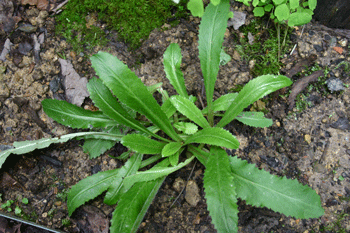
Branch Lettuce (out of stock) - Saxifraga micranthidifolia
1 lb. of fresh greens
is $12.00, plus over night shipping -
shipped with roots wrapped in wet paper towels to
preserve freshness of leaves. Email
to order.
Killed Lettuce - wash 1
lb. branch lettuce greens and put in bowl. Fry a few strips of real bacon in an
iron skillet, reserving the grease. Chop a bunch of wild onions, or if you can't
get wild onions, use green onions from the grocery store. Put the chopped onions
in the bowl with the branch lettuce and pour the very hot bacon grease over the
greens. Break up the bacon and put in the bowl too. Serve immediately and don't
tell your doctor what you been eating or he'll tell you bacon grease is bad for
your health. Yeah, and mountain folk lived a long time and they ate a lot of
real bacon too.
Real, old fashioned bacon from Benton's Smoky Mountain Hams. Benton's Smoky Mountain Country Hams - 2603 Hwy. 411 North. Madisonville, TN 37354-6356 - Phone: (423) 442-5003 - E-mail: info@bentonshams.com
Sheep Sorrel - Rumex acetosella - spring (March - April)
1 lb. greens is $10.00 plus overnight shipping
Dandelion Greens - Taraxacum officinale
1 lb. fresh greens is $5.00, plus shipping
Coming Soon ! Check the recipes link for recipes for poke greens!
Here's a "MUST READ" on poke recipes from
SouthernAngel.com - Poke Salet: The Versatile Veggie By: Angela Gillaspie
|
Pickled Poke Stalk Recipe
(Pokeweed pickles are often used in Japanese cuisine)
Collect tender stalks. Parboil to remove skins. Pack into jars. Combine 1 cup vinegar, 1/2 cup sugar, 1 tsp. salt, 1 stick cinnamon, several whole cloves. Boil; pour over poke stalks. Seal.
In order to comply with USDA food safety regulations, we do not sell nor provide anything containing meat, poultry, canned low acid foods, or dairy products. We sell herbs (plants) to be used as a novelty, religious, or food supplement only.